
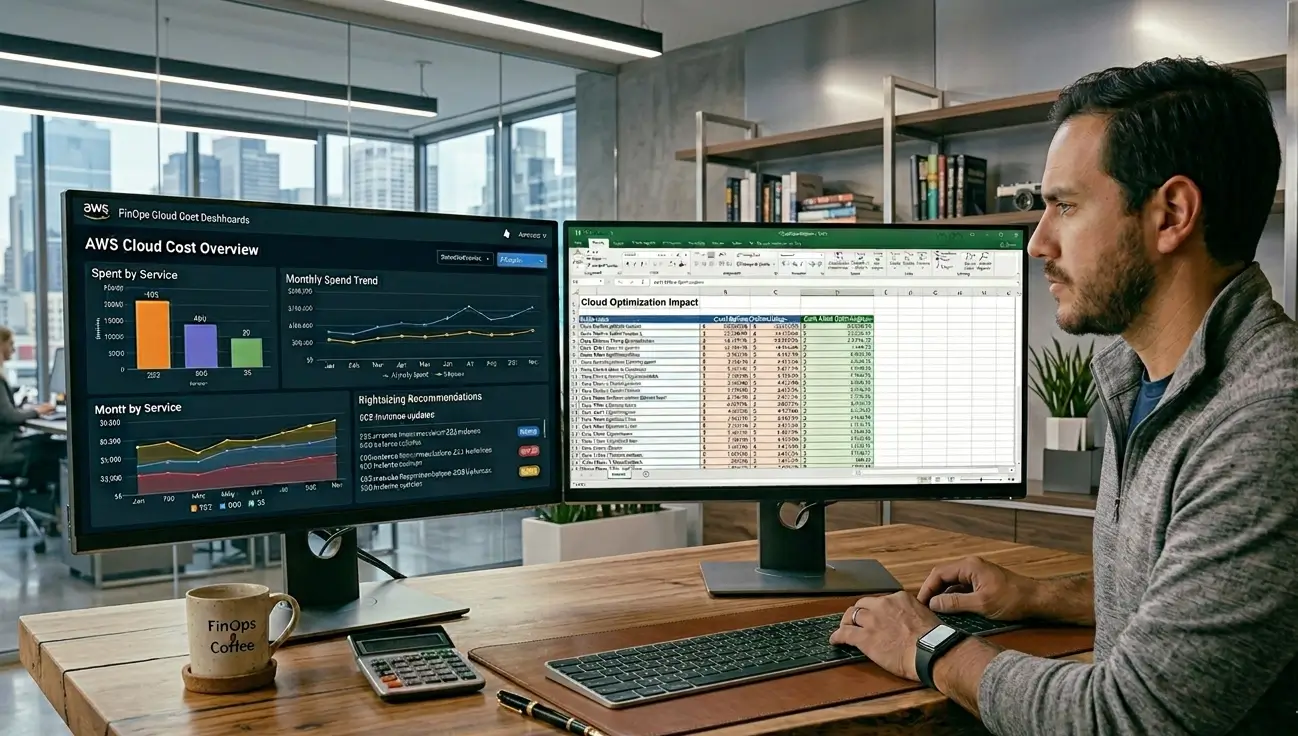
Cloud Cost Optimization
If you are evaluating cloud cost optimization services, the immediate problem is visible in your monthly bill: cloud spend is growing faster than your workloads justify, the engineering team cannot explain where a significant portion of that spend is going, and nobody owns the accountability for reducing it because cloud cost governance sits in the gap between finance and engineering where neither team has complete visibility or authority.
CodersLab connects US and international enterprises with certified FinOps and cloud cost optimization specialists across LATAM, covering cloud spend analysis, rightsizing implementation, reserved instance and savings plan portfolio management, cost allocation and chargeback frameworks, and the ongoing governance practices that prevent cloud waste from accumulating after the initial optimization is complete.
USD 44.5B in cloud waste projected for 2025
Enterprises will waste approximately USD 44.5 billion in unused cloud infrastructure in 2025; 72% of global companies exceeded allocated cloud budgets last fiscal year, and only 23% consider themselves highly efficient in managing cloud costs.
Harness & DataStack Hub Cloud Cost Statistics, 2025-202625-30% average monthly spend reduction
Enterprises with structured cloud cost optimization programs report 25-30% average monthly spend reduction; FinOps adoption grew 46% in 2025 as cost governance became a board-level priority, with 70% of large enterprises now maintaining a dedicated FinOps team.
DataStack Hub Cloud Cost Statistics, 2025-2026Cloud FinOps market: USD 15.90B in 2026

The Cloud FinOps market reached USD 15.90 billion in 2026 growing to USD 30.59 billion by 2032, as public cloud spending approaches USD 1.03 trillion in 2026 and cost governance becomes the primary cloud management challenge across enterprises.
360iResearch Cloud FinOps Market, March 2026Why cloud cost optimization is a board-level priority in 2026
The numbers make the case without needing interpretation: enterprises will waste approximately USD 44.5 billion in unused or underused cloud infrastructure in 2025 according to Harness research cited in Softjourn's 2026 FinOps statistics compilation; 72% of global companies exceeded their allocated cloud budgets in the last fiscal year; and only 23% of organizations consider themselves highly efficient in managing cloud costs according to DataStack Hub's 2025-2026 cloud cost statistics.
FinOps adoption grew by 46% in 2025 as cost governance became a board-level priority, and approximately 70% of large enterprises now maintain a dedicated FinOps or cloud economics team according to the same analysis; enterprises that implement structured cost optimization programs report an average 25-30% reduction in monthly cloud spend, which at enterprise scale represents millions of dollars annually that can be redirected to product development rather than infrastructure waste.
What cloud cost optimization services cover
Cloud cost optimization is not a one-time project, it is a continuous practice that requires both the technical analysis to identify waste and the organizational framework to prevent it from accumulating; the right scope depends on where your organization is in its FinOps maturity and what the primary drivers of your current cloud cost inefficiency are.
- Cloud spend analysis and waste identification: A structured audit of your cloud bills across AWS, Azure, and GCP to identify idle resources, oversized instances, orphaned storage, unused reserved capacity, and data transfer costs that are not generating business value; idle or underutilized resources account for an estimated 28-35% of total cloud waste according to DataStack Hub's analysis, and most organizations have never conducted a systematic audit of their cloud spend at the resource level.
- Rightsizing implementation: Analyzing the actual resource utilization of running workloads against their provisioned capacity and implementing the instance type changes, autoscaling policies, and scheduling configurations that align provisioned capacity with actual demand; rightsizing is typically the fastest-return optimization because it requires no architectural changes, only configuration changes that can be implemented in days rather than weeks.
- Reserved instance and savings plan optimization: Analyzing your usage patterns to determine the optimal mix of on-demand, reserved, and spot capacity that minimizes cost without compromising availability; reserved instances and savings plans can reduce compute costs by 40-72% compared to on-demand pricing according to AWS pricing documentation, but most organizations either over-purchase reservations for workloads that change or under-purchase for stable workloads that would benefit from commitment discounts.
- Cost allocation and chargeback frameworks: Implementing the tagging strategies, cost allocation rules, and reporting frameworks that make cloud spend visible and attributable to the business units, products, or teams that generate it; without cost allocation, cloud optimization is a finance problem rather than an engineering accountability problem, and the engineers making architecture decisions that affect cost have no visibility into the financial consequences of those decisions.
- FinOps governance implementation: Building the processes, tooling, and organizational structures that keep cloud cost governance operational on an ongoing basis rather than as a one-time optimization; FinOps adoption grew 46% in 2025 because organizations that implemented FinOps practices consistently maintain lower cloud waste than those that rely on periodic audits without continuous governance.
- AI-driven cost optimization: Implementing AI-powered anomaly detection, forecasting, and rightsizing recommendation tools that identify cost optimization opportunities faster than manual analysis; 48% of FinOps teams adopted AI-driven anomaly detection tools in 2025 according to Amnic's cloud cost trends analysis, driven by the recognition that cloud environments change too rapidly for manual monitoring to catch waste in real time.
The cloud cost waste problem that most organizations underestimate
The scale of cloud waste is consistently larger than most organizations realize before conducting a systematic audit; the gap between what organizations believe they are spending efficiently and what a structured analysis reveals is almost always significant, and the reasons for that gap are structural rather than careless.
- Over-provisioning at migration time: Organizations migrating from on-premises to cloud typically replicate their on-premises resource allocations, which were sized for peak load and typically run at 20-30% average utilization; moving those same allocations to the cloud at on-demand pricing means paying cloud rates for on-premises utilization patterns, which is the single largest source of cloud waste for organizations in their first two years of cloud operation.
- Development and test environment waste: Non-production environments that run 24/7 when they are only needed during business hours represent a significant and easily addressable source of waste; scheduling non-production environments to shut down outside working hours typically reduces their cost by 65-70% with no impact on developer productivity.
- Data transfer costs: Inter-region and egress data transfer costs are consistently underestimated in cloud architecture decisions because they are not visible in the design phase; architectures that move data frequently between regions or between cloud and on-premises environments generate transfer costs that are invisible in resource-level billing but significant in total cloud spend.
- Orphaned resources: Storage volumes, snapshots, load balancers, and IP addresses that were attached to deleted resources but were not cleaned up continue generating cost indefinitely; most organizations that have operated in the cloud for more than two years have accumulated orphaned resources that represent 5-10% of total cloud spend with zero business value.
Cloud cost optimization with LATAM FinOps specialists through CodersLab
The Cloud FinOps market reached USD 15.90 billion in 2026 and is projected to reach USD 30.59 billion by 2032 at an 11.48% CAGR according to 360iResearch's March 2026 analysis; public cloud spending is projected to reach USD 1.03 trillion in 2026 according to Forrester, creating the cost governance imperative that is driving FinOps adoption across organizations of all sizes.
CodersLab connects enterprises with AWS Cost Optimization and FinOps Foundation certified specialists based across LATAM, working within one to four hours of U.S. Eastern Time; according to Howdy's 2025 salary benchmarks, LATAM FinOps and cloud specialists cost 50-75% less than equivalent US-based professionals, making structured cloud cost optimization programs financially viable for mid-market organizations where the optimization savings need to exceed the consulting investment within the first two to three months of engagement.
How CodersLab structures cloud cost optimization engagements
Optimization engagements start with a cloud spend audit that maps your current billing against resource utilization, identifies the specific waste categories and their dollar values, and produces a prioritized optimization roadmap ranked by savings potential and implementation effort; most audits complete within one to two weeks and the findings define the engagement scope and expected ROI before implementation begins.
Implementation follows the audit, starting with the highest-return optimizations, rightsizing and orphaned resource cleanup, and progressing to reserved instance portfolio optimization and FinOps governance implementation; most organizations achieve the majority of their optimization savings within the first four to six weeks, with ongoing governance practices sustaining those savings and preventing new waste from accumulating.
Frequently Asked Questions
Enterprises with structured cloud cost optimization programs report an average 25-30% reduction in monthly cloud spend according to DataStack Hub's 2025-2026 analysis; specific savings depend on current waste levels, which vary significantly by organization. A cloud spend audit at the start of the engagement quantifies the specific optimization opportunities and expected savings before implementation begins.
Cloud cost optimization identifies and eliminates existing waste through technical changes - rightsizing, reserved instances, orphaned resource cleanup; it is a project with a defined end. FinOps is the ongoing practice of financial accountability for cloud spend that prevents waste from accumulating after optimization; it is a continuous discipline that embeds cost awareness into engineering decisions. Most mature cloud cost programs combine both: optimization to capture immediate savings and FinOps governance to sustain them.
Rightsizing and orphaned resource cleanup typically produce savings within the first two to four weeks of implementation; these are configuration changes that require no architectural redesign. Reserved instance portfolio optimization takes four to six weeks to analyze and implement correctly. FinOps governance practices take eight to twelve weeks to implement fully; the combination of all three typically produces the majority of achievable savings within the first 60 to 90 days.
Rightsizing matches provisioned cloud resources to actual workload requirements by analyzing utilization data and implementing appropriate instance types, autoscaling policies, and scheduling configurations; on-premises servers typically run at 20-30% average utilization, and organizations that migrated those allocations to cloud without rightsizing are paying cloud prices for unused capacity. Rightsizing alone typically reduces compute costs by 15-25% for organizations that have not previously optimized their instance fleet.
LATAM FinOps and cloud specialists cost 50-75% less than equivalent US-based professionals according to Howdy's 2025 salary benchmarks; for most mid-market organizations, the optimization savings achieved in the first month exceed the total cost of the engagement. A cloud spend audit at the start of the engagement produces the savings estimate that makes the ROI case before implementation investment is committed.
CodersLab's cloud cost optimization specialists cover AWS, Microsoft Azure, and Google Cloud Platform, including multi-cloud environments where spend is distributed across multiple providers; multi-cloud cost visibility is one of the most common optimization challenges because consolidated billing across providers requires tooling and expertise that most internal teams have not implemented.
CodersLab's FinOps specialists use native cloud tools including AWS Cost Explorer, Azure Cost Management, and GCP Cost Management alongside third-party platforms including CloudHealth, Apptio Cloudability, nOps, and Finout for multi-cloud visibility; AI-driven anomaly detection and rightsizing tools are implemented for organizations that need real-time cost governance rather than periodic manual review.
Preventing cost regression after optimization requires FinOps governance practices: cost allocation tagging that makes spend visible and attributable to engineering teams, budget alerts that detect anomalous spend before it compounds, regular optimization review cycles, and engineering accountability frameworks that embed cost awareness into architecture decisions before resources are provisioned rather than after costs are incurred.
Specialties & Solutions



Need a tech team?
We build and scale nearshore development teams for companies from startups to Fortune 500. +1,200 projects delivered for over 500 companies across LATAM.

Our process. Simple, seamless, streamlined.

Step 1

Let's schedule a strategic call
Tell us about your project in an exploratory session. We'll discuss team structure, technical needs, timelines, budget, and the skills needed to find the best solution for you.
Step 2

We design the solution and select your teams
In just a few days, we define project details, agree on the work model, and select the ideal talent for you. We ensure each profile integrates quickly and effectively.
Step 3

We launch and optimize performance
With agreed milestones, the team starts working immediately. We track progress, provide continuous reports, and adapt to your needs to ensure the best results.