
Vulnerability Assessment Services
If you are evaluating vulnerability assessment services, the core problem is not finding every vulnerability in your environment, automated scanners can produce lists of thousands of CVEs in hours; the problem is knowing which of those vulnerabilities represent real risk to your specific environment, which ones an attacker would chain together to reach your sensitive data, and in what order your team should fix them to reduce actual exposure rather than just reducing vulnerability count.
CodersLab connects US and international enterprises with certified vulnerability assessment specialists across LATAM, covering network, application, cloud, and API assessments with risk-based prioritization that maps findings to your specific business context, compliance requirements, and remediation capacity, with full US timezone alignment and specialists who hold Tenable, Qualys, and security assessment certifications.
Vulnerability management market: USD 18.88B in 2026

The security and vulnerability management market reached USD 18.88 billion in 2026 and is projected to reach USD 34.01 billion by 2035, with North America holding 38% share and vulnerability assessment representing 33.12% of total spending.
Precedence Research & Mordor Intelligence, 2025-2026VA services market: USD 5.58B in 2025

The vulnerability assessment services market reached USD 5.58 billion in 2025 and is forecast to reach USD 8.66 billion by 2030 at 9.2% CAGR, with the SME segment growing fastest at 11.0% CAGR as managed assessment offerings expand.
Mordor Intelligence Vulnerability Assessment Market, 2025API vulnerabilities: fastest-growing attack vector

API vulnerabilities are among the fastest-growing attack vectors as organizations expose more business logic through APIs; the cloud vulnerability assessment segment is expanding at the highest CAGR as cloud workloads outpace legacy security models.
Precedence Research Security & Vulnerability Management, February 2026Why vulnerability assessment is a USD 18.88 billion market in 2026
The security and vulnerability management market reached USD 18.88 billion in 2026 and is projected to reach USD 34.01 billion by 2035, growing at a CAGR of 6.77% according to Precedence Research; North America accounts for 38% of global market share, and vulnerability assessment services represent 33.12% of total security and vulnerability management spending according to Mordor Intelligence's 2025 segmentation data.
The market growth is driven by two converging pressures: the increasing frequency of known-exploit cyberattacks where attackers use publicly documented vulnerabilities that organizations failed to remediate, and regulatory mandates including PCI DSS, HIPAA, ISO 27001, and the EU's DORA and NIS2 directives that explicitly require continuous vulnerability assessment and documented remediation processes; organizations that cannot demonstrate a systematic vulnerability management program are failing audits and facing fines in addition to the breach risk.
What vulnerability assessment services cover
Vulnerability assessment is not a single activity, it is a continuous process that covers different attack surfaces and requires different methodologies depending on what is being assessed; the right scope depends on your environment, your compliance requirements, and how your organization wants to consume and act on assessment findings.
- Network vulnerability assessment: Scanning your network infrastructure, including servers, firewalls, routers, and endpoints, for known vulnerabilities using industry-standard tools including Tenable Nessus, Qualys, and Rapid7; network assessments identify unpatched systems, weak configurations, and exposed services that represent the most commonly exploited entry points in external attacks.
- Web application vulnerability assessment: Scanning web applications for OWASP Top 10 vulnerabilities including injection flaws, broken authentication, insecure deserialization, and security misconfigurations; web application assessment is required for PCI DSS compliance for any application that processes payment card data and is increasingly expected by SOC 2 auditors as evidence of secure development practices.
- Cloud vulnerability assessment: Evaluating your AWS, Azure, and GCP environments for misconfigurations, excessive IAM permissions, exposed storage resources, and compliance gaps against CIS benchmarks and cloud security best practices; the cloud security segment of vulnerability management is expanding at the highest CAGR according to Precedence Research 2026 data, reflecting the rapid migration of vulnerable workloads to cloud environments.
- API vulnerability assessment: Assessing your APIs for the OWASP API Security Top 10 including broken object level authorization, excessive data exposure, and lack of rate limiting; API vulnerabilities are among the fastest-growing attack vectors as organizations expose more business logic through APIs, and the API vulnerabilities segment is expected to grow at a significant CAGR through 2035 according to Precedence Research.
- Risk-based vulnerability prioritization: Moving beyond raw CVSS scores to prioritize remediation based on actual exploitability in your environment, presence of public exploit code, business criticality of the affected asset, and your team's remediation capacity; organizations that prioritize by risk rather than by score consistently reduce their actual attack surface faster than those working through vulnerability lists by severity alone.
The difference between vulnerability assessment and penetration testing
Vulnerability assessment and penetration testing are complementary but distinct services that organizations frequently conflate, and choosing the wrong one for a given objective wastes budget and leaves security gaps that the chosen service wasn't designed to find.
A vulnerability assessment identifies weaknesses systematically across your environment using automated scanning augmented by specialist review; it is broad in scope, designed to find as many vulnerabilities as possible across a wide attack surface, and produces a prioritized remediation list. A penetration test actively exploits vulnerabilities to demonstrate what an attacker could actually do with what is there; it is narrower in scope, requires more specialist time, and produces evidence of exploitability rather than just existence.
Most mature security programs run both: continuous vulnerability assessment to maintain visibility into their exposure, and periodic penetration testing to validate that the highest-risk vulnerabilities are actually exploitable and to identify attack chains that automated scanning misses; starting with vulnerability assessment is the right sequence because it builds the baseline visibility that makes penetration test scope decisions more informed and cost-efficient.
What a quality vulnerability assessment report includes
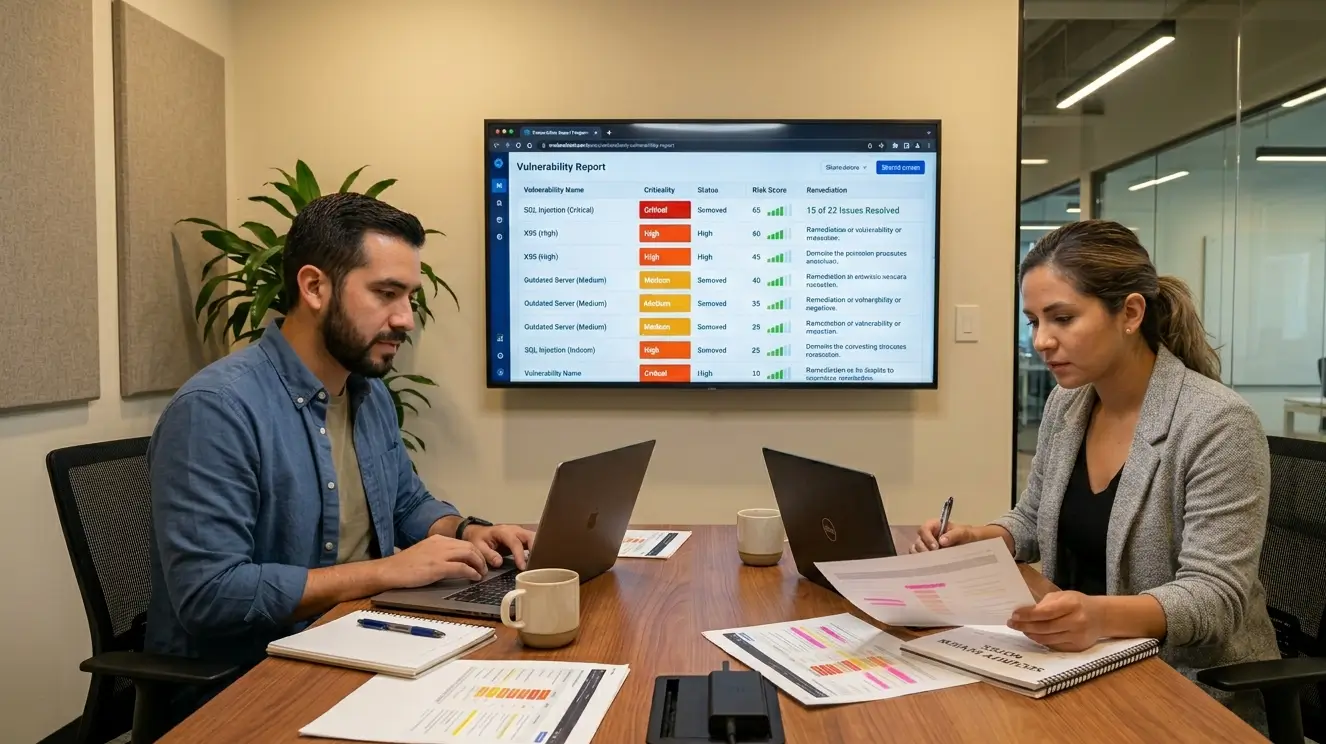
The value of vulnerability assessment services is largely in the quality of the output; a report that lists CVEs with CVSS scores and generic remediation links is not actionable for most engineering teams, and the gap between a vulnerability list and a remediation program is where most vulnerability assessment investments fail to deliver their expected value.
- Executive summary: A non-technical overview of the assessment scope, key findings, and the overall security posture relative to industry benchmarks, designed for CISO, CTO, or board-level consumption without requiring technical interpretation.
- Risk-based finding prioritization: Each finding ranked not just by CVSS score but by actual exploitability in your environment, presence of active exploit code, and business impact of the affected asset; organizations that receive risk-prioritized findings fix the right vulnerabilities first rather than fixing the most technically severe ones that may not be reachable by an external attacker.
- Remediation guidance specific to your stack: Actionable remediation steps that account for your specific technology stack, not generic recommendations that require additional research to translate into actual configuration changes or patch procedures.
- Compliance mapping: Each finding mapped to the specific compliance controls it affects, whether PCI DSS requirements, HIPAA safeguards, SOC 2 criteria, or ISO 27001 controls, so that remediation effort also advances compliance posture rather than treating security and compliance as separate workstreams.
Vulnerability assessment services with LATAM specialists through CodersLab
The vulnerability assessment services market is projected to reach USD 8.66 billion by 2030 according to Mordor Intelligence, growing at a 9.2% CAGR from its 2025 value of USD 5.58 billion; the SME segment is expanding at the fastest pace at 11.0% CAGR as smaller organizations increasingly adopt managed vulnerability assessment offerings that give them enterprise-grade security visibility without requiring internal security team headcount.
CodersLab connects enterprises with certified vulnerability assessment specialists based across LATAM, holding Tenable Certified Security Engineer, Qualys Certified Specialist, and security assessment certifications, working within one to four hours of U.S. Eastern Time; LATAM cybersecurity specialists cost 50-75% less than equivalent US-based professionals according to Howdy's 2025 salary benchmarks, making structured vulnerability assessment programs financially viable for mid-market organizations that cannot justify US-rate security consulting fees for continuous assessment coverage.
How CodersLab structures vulnerability assessment engagements
Engagements start with a scoping call to define the assessment boundaries, compliance frameworks that findings need to map to, and the format and frequency of reporting that works for your remediation team; point-in-time assessments complete within one to three weeks depending on scope, while continuous vulnerability management programs operate on a monthly or quarterly cadence with standing reporting cycles.
All assessment reports are structured to satisfy the documentation requirements of PCI DSS, SOC 2, ISO 27001, and HIPAA auditors, and findings include compliance mapping so that remediation effort advances both security and compliance posture simultaneously rather than requiring separate documentation workstreams for each framework.
Frequently Asked Questions
Vulnerability assessment identifies weaknesses across your environment systematically using automated scanning augmented by specialist review; it is broad in scope and produces a prioritized remediation list. Penetration testing actively exploits vulnerabilities to demonstrate what an attacker could actually do; it is narrower in scope and requires more specialist time. Most mature security programs run both, starting with vulnerability assessment to build baseline visibility.
PCI DSS requires internal and external vulnerability scanning at least quarterly and after any significant network change. SOC 2 auditors expect evidence of regular assessments for the Security trust criteria. Outside compliance requirements, organizations with active cloud environments or regular application deployments benefit from continuous or monthly vulnerability assessment programs, as new infrastructure changes introduce new vulnerabilities faster than quarterly assessments can track.
A comprehensive vulnerability assessment covers network infrastructure including servers, firewalls, and endpoints; web applications for OWASP Top 10 vulnerabilities; cloud environments in AWS, Azure, and GCP for misconfigurations and compliance gaps; and APIs for the OWASP API Security Top 10. Scope is defined during the initial scoping call based on your environment, compliance requirements, and remediation capacity.
Point-in-time vulnerability assessments complete within one to three weeks depending on scope; a single web application assessment typically takes three to five business days, while a full network and cloud assessment for an enterprise environment takes two to three weeks. Continuous vulnerability management programs operate on a monthly or quarterly cadence with standing reporting cycles.
LATAM cybersecurity specialists cost 50-75% less than equivalent US-based professionals according to Howdy's 2025 salary benchmarks, making structured vulnerability assessment programs financially viable for mid-market organizations that cannot justify US-rate security consulting fees. Specific engagement costs depend on scope, number of assets, and assessment frequency; a scoping call provides an accurate estimate.
Vulnerability assessment reports through CodersLab map findings to PCI DSS requirements, SOC 2 Security criteria, ISO 27001 controls, and HIPAA technical safeguard requirements. Compliance mapping means that remediation effort advances both security and compliance posture simultaneously rather than requiring separate documentation for each framework.
CodersLab's vulnerability assessment specialists use industry-standard platforms including Tenable Nessus and Tenable.io for network and cloud scanning, Qualys for continuous vulnerability management, Rapid7 InsightVM for risk-based prioritization, and Burp Suite for web application assessments. Tool selection is matched to the assessment type and the client's existing security tooling where applicable.
Risk-based prioritization ranks vulnerabilities by actual exploitability in your environment, presence of active exploit code, and business criticality of the affected asset, rather than by CVSS score alone. Organizations that prioritize by risk consistently reduce their actual attack surface faster than those working through vulnerability lists by severity, because high-CVSS vulnerabilities are often not reachable by external attackers while lower-scored ones may be directly exploitable.
Specialties & Solutions




Need a tech team?
We build and scale nearshore development teams for companies from startups to Fortune 500. +1,200 projects delivered for over 500 companies across LATAM.

Our process. Simple, seamless, streamlined.

Step 1

Let's schedule a strategic call
Tell us about your project in an exploratory session. We'll discuss team structure, technical needs, timelines, budget, and the skills needed to find the best solution for you.
Step 2

We design the solution and select your teams
In just a few days, we define project details, agree on the work model, and select the ideal talent for you. We ensure each profile integrates quickly and effectively.
Step 3

We launch and optimize performance
With agreed milestones, the team starts working immediately. We track progress, provide continuous reports, and adapt to your needs to ensure the best results.