
AI Strategy Consulting
If you are evaluating AI strategy consulting, the gap you are trying to close is not between knowing that AI matters and not knowing it - it is between having an AI vision and knowing which specific bets to make first, how to sequence them, and how to build the internal capability to execute without depending on a consulting firm indefinitely.
CodersLab delivers AI strategy consulting through senior engineers and AI architects based across LATAM, combining strategic advisory with hands-on implementation capability so the strategy produced in the consulting engagement is the same one the delivery team executes - without the translation loss that happens when strategy and implementation are split between two different firms.
AI consulting market: USD 116.63B by 2035

The global AI consulting market reaches USD 14.07 billion in 2026 and is projected to hit USD 116.63 billion by 2035 at a 26.49% CAGR, driven by enterprise demand for strategic AI guidance that goes beyond tool deployment.
Business Research Insights, 2026BCG: 25% of USD 14.4B revenue from AI work

Boston Consulting Group reported that 25% of its USD 14.4 billion in 2025 revenue came directly from AI consulting work - confirming that AI strategy has become the primary growth driver for the world's leading consulting firms.
Bloomberg via Metaintro, April 202674% of orgs say AI accelerated data analysis

74% of organizations report AI technologies accelerated data analysis according to Deloitte, while EY found 84% of business leaders say AI improved forecasting accuracy - the outcomes that AI strategy consulting is designed to make systematic.
Deloitte & EY, cited by Future Market Insights, 2025-2026Why AI strategy consulting demand is accelerating in 2026
The global AI consulting market reached USD 14.07 billion in 2026 and is projected to reach USD 116.63 billion by 2035, growing at a CAGR of 26.49% according to Business Research Insights; that growth reflects a specific problem that most enterprises face in 2026 - they have invested in AI tools, built some pilots, and now need a coherent strategy that prioritizes the right use cases, sequences the right investments, and builds the organizational capability to scale without creating technical debt that will limit flexibility in two years.
The demand signal from the consulting industry itself is clear: BCG reported that 25% of its USD 14.4 billion in 2025 revenue - approximately USD 3.6 billion - came directly from AI-related consulting work, according to Bloomberg; that single data point confirms that AI strategy is no longer a specialty practice bolted onto traditional consulting engagements, it is the primary growth driver for the firms that understand what enterprise AI adoption actually requires.
What AI strategy consulting actually delivers
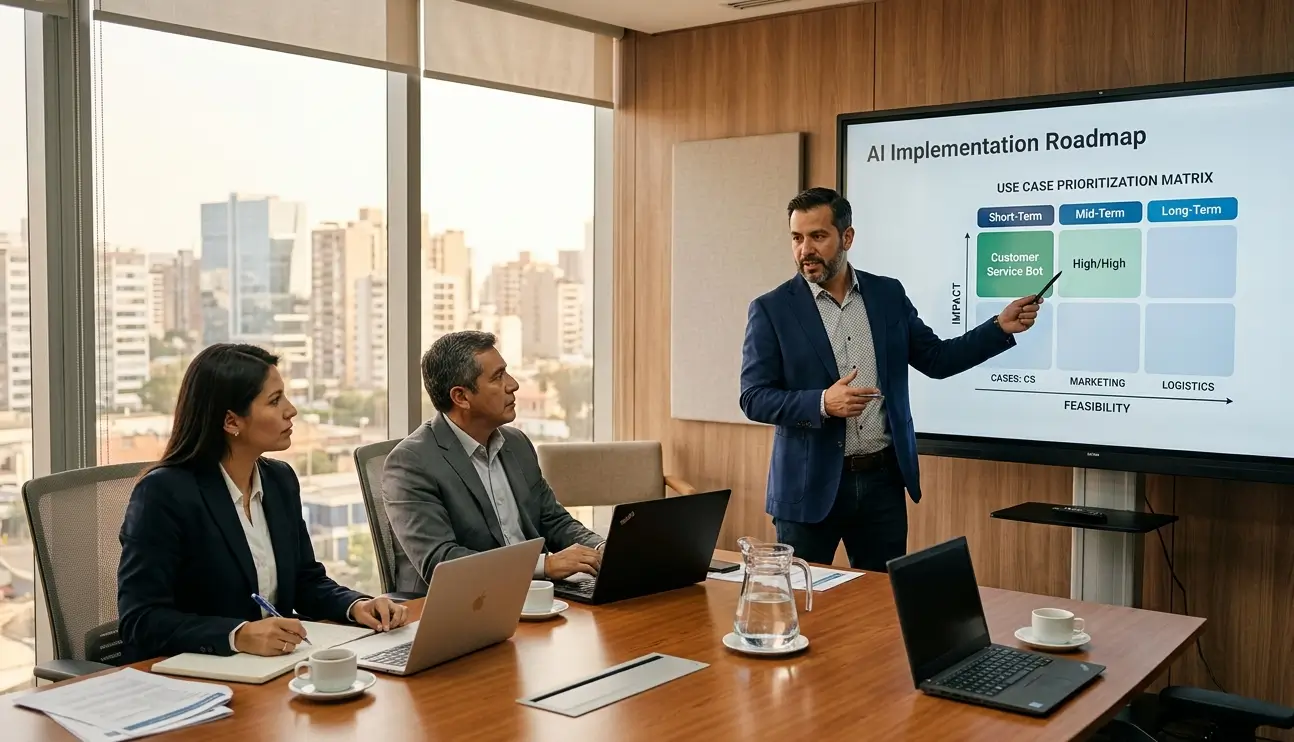
AI strategy consulting at its best produces three outputs that an internal team cannot produce on its own: an honest assessment of where the organization actually stands relative to AI maturity, a prioritized roadmap of use cases ranked by feasibility and business impact, and a governance framework that keeps AI investments aligned with business objectives as the technology and the organization both evolve.
- AI maturity assessment: An honest baseline of current AI capabilities, data infrastructure, talent, and tooling relative to the use cases the organization wants to pursue; without this baseline, roadmaps are built on assumptions that surface as blockers six months into implementation.
- Use case prioritization: A structured evaluation of AI opportunities ranked by business impact, technical feasibility, data readiness, and time to value; most organizations identify 20 to 40 potential AI use cases and have the capacity to pursue three to five well - the prioritization work is where AI strategy consulting creates the most durable value.
- Implementation roadmap: A sequenced plan that accounts for dependencies between use cases, builds organizational capability progressively, and avoids the architectural decisions that create technical debt - particularly around data infrastructure and model governance - that limits optionality later.
- Governance and risk framework: Policies, processes, and accountability structures for AI development, deployment, and monitoring that satisfy both internal stakeholders and emerging regulatory requirements, including the EU AI Act for organizations operating in European markets.
- Build vs. buy analysis: A structured evaluation of which AI capabilities to build internally, which to buy from vendors, and which to source through partnerships - a decision that has significant cost and strategic implications that most internal teams lack the market context to make well.
What separates AI strategy consulting that creates value from the kind that produces slide decks
The most common failure mode in AI strategy consulting is a beautifully structured 80-page strategy document that sits in a shared drive while the organization continues doing what it was already doing; the document fails not because the analysis was wrong but because the strategy was designed for a generic enterprise rather than for the specific people, systems, and constraints of the organization that commissioned it.
- Specificity over frameworks: A strategy built around your specific data assets, your specific technical constraints, and your specific competitive context is worth more than a framework applied from a previous engagement; ask specifically how much of the deliverable will be original analysis versus adapted templates.
- Implementation continuity: The consulting team that defines the strategy should have a clear handoff plan to the implementation team, whether internal or external; strategies that are handed off cold to a different team lose 30 to 50% of their actionable value in the translation.
- Measurable milestones: Every element of the AI strategy roadmap should have a defined success metric and a realistic timeline; strategies built around capabilities rather than outcomes are hard to prioritize and impossible to hold anyone accountable for delivering.
- Honest feasibility assessment: A good AI strategy consulting engagement will tell you which use cases are not worth pursuing given your current data, talent, and infrastructure - that negative signal is as valuable as the positive roadmap, and providers who only tell you what is possible are not doing the hard work.
AI strategy consulting for enterprises in 2026
According to a Deloitte survey, 74% of organizations reported that AI technologies helped them accelerate data analysis processes, and EY found that 84% of business leaders agreed that AI improved their forecasting accuracy; but Accenture research found that three out of four C-suite executives believe that if they don't effectively scale AI in the next five years, they risk going out of business - a statistic that explains both the urgency of demand for AI strategy consulting and the risk of getting the strategy wrong.
The organizations that are winning in AI in 2026 are not the ones that moved fastest to deploy the most tools; they are the ones that made a small number of deliberate strategic bets, built the data and organizational infrastructure to execute them well, and created internal capability that compounds over time rather than depending on external consultants for every subsequent decision. That is what good AI strategy consulting is designed to produce.
AI strategy consulting with LATAM engineers through CodersLab
CodersLab's AI strategy consulting engagements are led by senior AI architects and data strategists with production experience building AI systems for US and international companies across fintech, healthtech, retail, and enterprise SaaS; they work within one to four hours of U.S. Eastern Time, making it possible to run working sessions, review findings, and iterate on recommendations at the pace that strategy work requires - not through asynchronous documents passed back and forth across a 12-hour time difference.
The engagement model is designed to avoid the consulting trap: CodersLab's strategy consultants work directly with the engineering teams who will implement the roadmap, which means the strategy is grounded in what is actually buildable with your current infrastructure and team, not what would be buildable in an ideal scenario. The output is a roadmap that a real team can execute, not a presentation that requires a separate implementation engagement to make operational.
How CodersLab structures AI strategy consulting engagements
AI strategy engagements are scoped based on organizational complexity and the maturity of existing AI initiatives; a focused maturity assessment and use case prioritization can be completed in four to six weeks, while a comprehensive AI strategy including governance framework and multi-year roadmap typically takes eight to twelve weeks.
The process starts with a discovery call to assess current state, identify the decisions that need to be made, and define the scope of the engagement; most AI strategy consulting clients at CodersLab move directly into implementation planning at the end of the strategy phase, using the same team to execute the roadmap they helped define.
Frequently Asked Questions
A completed AI strategy consulting engagement delivers an AI maturity assessment, a prioritized use case roadmap ranked by business impact and feasibility, a build-vs-buy analysis, an implementation sequence with defined milestones, and a governance framework. The output should be specific to your organization, not a generic framework adapted from a template.
A focused AI maturity assessment and use case prioritization takes four to six weeks. A comprehensive AI strategy including governance framework and multi-year implementation roadmap typically takes eight to twelve weeks. Timeline depends on organizational complexity and the maturity of existing AI initiatives assessed in the discovery call.
AI strategy consulting defines what to build, in what order, and why - it is the advisory work that produces the roadmap. AI implementation is the engineering work that executes the roadmap. At CodersLab, both are delivered by overlapping teams, so the strategy is grounded in implementation reality and the implementation follows a coherent strategic direction.
AI strategy consulting engagements at CodersLab are priced based on scope and duration. Focused assessments start at a lower engagement cost than comprehensive multi-year strategy work. LATAM-based consultants cost 50-75% less than equivalent US-based consultants according to Howdy's 2025 benchmarks, without sacrificing seniority or delivery quality.
CodersLab's AI strategy consulting covers financial services, healthtech, retail, logistics, enterprise SaaS, and manufacturing - industries where AI use cases are most mature and where the implementation risks of a poorly sequenced strategy are highest. Sector-specific experience matters because the data infrastructure, regulatory constraints, and competitive dynamics vary significantly by industry.
Use case prioritization evaluates each candidate use case across four dimensions: business impact, technical feasibility given current data and infrastructure, time to value, and organizational readiness. The output is a ranked list with a recommended sequence that builds capability progressively and avoids architectural decisions that create technical debt in later phases.
The most common failure mode is a strategy that is too generic to be actionable - built around frameworks rather than your specific data assets, technical constraints, and competitive context. The second most common failure is a strategy handed off cold to an implementation team that had no input into the strategic decisions, resulting in a plan that is theoretically sound but practically unexecutable.
Yes. AI governance is included as a standard component of comprehensive AI strategy engagements, covering accountability structures, model monitoring policies, bias and fairness frameworks, and compliance with emerging regulations including the EU AI Act. For organizations in regulated industries, governance design starts in the strategy phase rather than being retrofitted after deployment.
Specialties & Solutions






Need a tech team?
We build and scale nearshore development teams for companies from startups to Fortune 500. +1,200 projects delivered for over 500 companies across LATAM.

Our process. Simple, seamless, streamlined.

Step 1

Let's schedule a strategic call
Tell us about your project in an exploratory session. We'll discuss team structure, technical needs, timelines, budget, and the skills needed to find the best solution for you.
Step 2

We design the solution and select your teams
In just a few days, we define project details, agree on the work model, and select the ideal talent for you. We ensure each profile integrates quickly and effectively.
Step 3

We launch and optimize performance
With agreed milestones, the team starts working immediately. We track progress, provide continuous reports, and adapt to your needs to ensure the best results.